AR2192 continues to grow and evolve as it moves across the center of the sun's disk. An X-Class flare from this spot would likely bring significant auroral activity. This image was taken through a haze of cloud, so the contrast is fairly washed out in terms of fine surface detail.
The trials, tribulations and small triumphs of a Charlotte, NC astronomer imaging under Bortle 8/9 skies.
Friday, October 24, 2014
Thursday, October 23, 2014
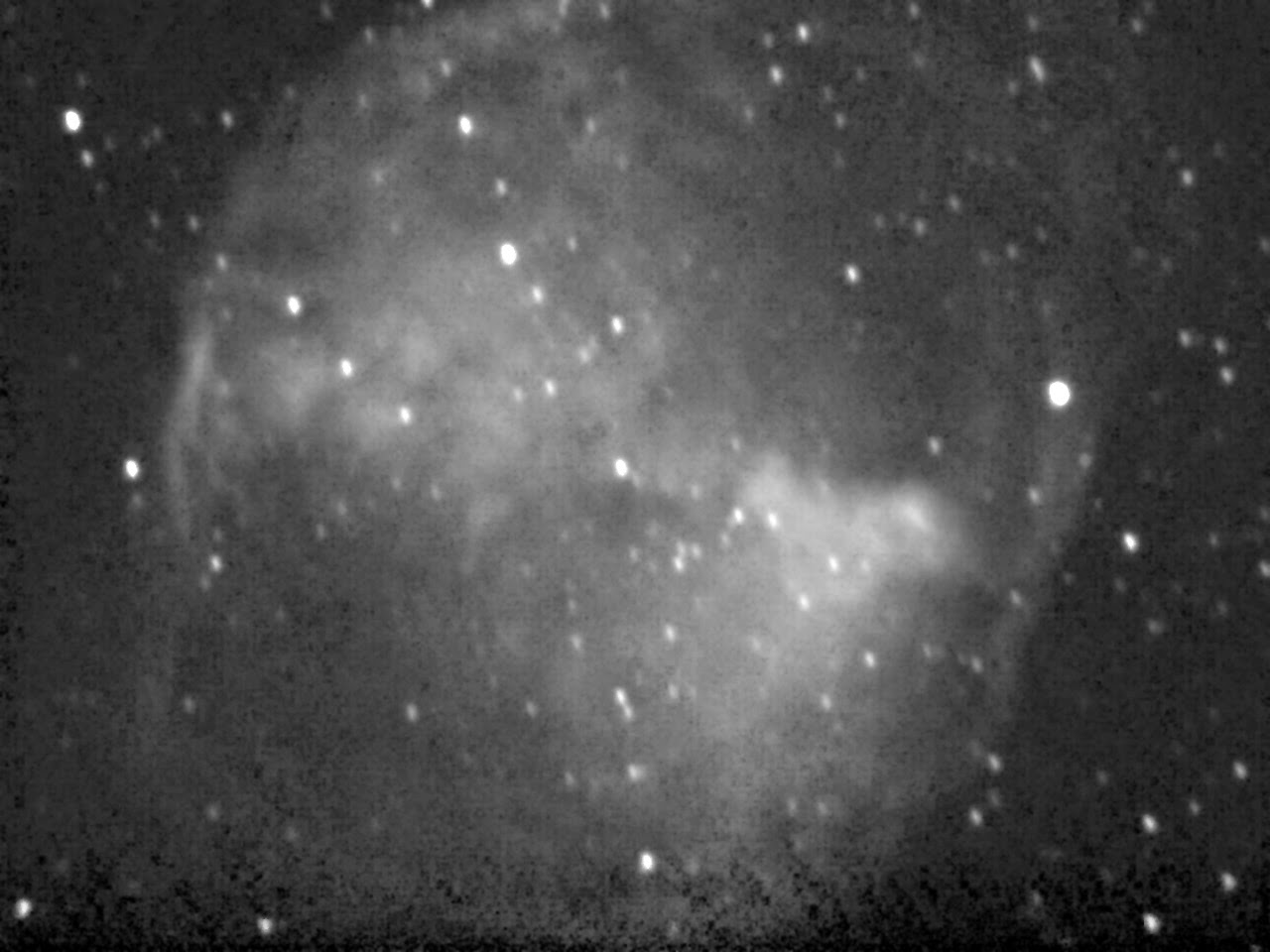
The Dumbbell Nebula 10.22.2014
Like the Ring Nebula, the Dumbbell nebula is a planetary nebula marking the end of a star's life as it puffs off its outer layers into space. The central star of the nebula is the largest known white dwarf. The shape of the nebula is an oblate spheroid and we are looking at the plane of its equator. The rate of expansion is around 17 km per second. This image is a stack of 20 15-second exposures with the ASI 120MM camera.
The Ring Nebula 10.22.2014
Last night, I decided to do a quick imaging session with the ASI 120MM camera. It is amazingly sensitive. This image is a stack of 17 10-second exposures. I did not use the color wheel last night as the goal of the session was to see how the Orion focal reducer worked with the 14 inch.
The Ring Nebula is a planetary nebula, which is an emission nebula of ionized gas. This gas is a "shell" puffed off from the surface of an old, red giant star as it reaches the end of its life. The shell is a cylinder we are seeing from "end on," and it is expanding at around 30 km per second. The center of the nebula is expanding faster than the ring. The central star is a white dwarf about the size of earth and it glows at around Magnitude 14.7.
Wednesday, October 22, 2014
AR2192--A Fire-Spitting Dragon! (October 22, 2014)
Monday, October 20, 2014
The Sun on 10.19.2014
It was not a good day for imaging, with lots of hazy cloud that significantly reduced image contrast. The sun continues to be very active. The following images show AR2192, which has been torching off X-Class flares (the most powerful flares the sun emits), and also filaments around ARs 2193 and 2187.
![]() |
| AR2192 |
![]() |
| Filaments near AR2187 & AR2193 |
Thursday, October 9, 2014
New Imager and Pix
Yesterday, I received my new Mallincam Jr Pro. As whoever controls the weather seems to have been asleep, the weather was clear last night. I made some quick adjustments, added a .5x focal reducer and skyglow filter, and attached the camera to the scope. Here is the first thing I saw:
This image is a pic captured with my iphone off the small (and rather low-quality) monitor mounted on the scope. It is a 3-second integration and yet the colors are clearly visible, as is the 14.7 magnitude central star! This is all the more impressive as there was a full moon last night and a hazy sky.
One issue I had with the camera is that I was unable to achieve long integrations. When I programmed for, say, a 30-second exposure, the remote controls did appear to be performing the exposure, but the camera continued to update every 3 seconds. With a longer exposure, even more vivid color and structure would be visible.
Here's a pic of the camera itself. It's a beautiful piece of work hand-built and signed by Rock Mallin himself. The only problem is that the supplier I bought it from (not the US supplier) sent the wrong camera. I had ordered one with the enhanced imaging ship but they shipped the standard model by mistake. I returned the above camera today and I'm hoping it won't be too long until the new one is shipped. As we have about a week of rain ahead, I'm not too disappointed!
Here are a couple more images I took last night:
M13 is always gorgeous and even a 3-second exposure shows lots of stars.
The Dumbell Nebula is one of my favorite objects and, like the Ring Nebula, is well-placed for observation at this time of year. A 3-second exposure is much too short for this object, but the image above still shows significant color and detail (the image on the screen was significantly better than this capture).
All in all, I'm looking forward to using this little camera as an adjunct to my CCD imaging. I recommend it highly to anyone who does public outreach, or who just wants to see color images of DSOs in record time!
Thursday, September 25, 2014
Solar Images for September 25, 2014
The sun is quite active at present and the disk has lots of interesting features in H-Alpha, from filaments to active areas that can produce powerful flares.
This first image shows AR 2172. This area has the potential to produce M-Class flares and has been flaring occasionally for several days. Notice the dark filaments that stretch for huge distances across the solar disk. The dark spots in AR 2172 are a little bigger than the diameter of the earth.
Below are more images of this area:
The next image shows another active area on the disk, This area has a few, pore like spots in white light images, but is not named. It gives a good idea of the complex swirl and flow of plasma in the sun's magnetic field.
Subscribe to:
Posts (Atom)
20 Hours of WR 134 with the Seestar S50
This image is a 20+ hour integration on WR 134, which is a highly energetic Wolf-Rayet star. The blue shockwave is oxygen ionized by the int...
-
I had a couple of emails asking how to defork an ETX telescope. The ETX 90 and ETX 125 were optically superb scopes, but the mounts left a...
-
M17, the Omega Nebula (among other names). M17 is one of the brightest and most massive stellar nurseries in the galaxy. The open cluster o...
-
The ZEQ25 doing its stuff on a cold night--imaging the Orion Nebula with an 8 inch f/4 astrograph. Note the lovely Christmas rug :) As ...


.jpg)

.jpg)