
Monday, March 16, 2015
Sun Pillar
I was driving home last night, enjoying a spectacular sunset. As it developed, a sun pillar appeared. The pillar seemed to spread from a bright, compact core (visible in the image; the sun was actually below the horizon). It looked like a faint cross for a while (but very different and much smaller than those associated with Sun Dogs). So here's the pic--a lovely interaction between an astronomical object, our sun, and the ice crystals in our atmosphere.

Wednesday, March 11, 2015
The Orion Region
Tonight I imaged a larger part of the Orion nebula complex using the Orion 80mm ED apochromat mounted on the 14 inch. The poor quality Meade diagonal I use with the Orion fell apart twice and the camera dropped 5 feet onto solid concrete. It is a testimony to the quality of Mallincam products that the camera was completely unaffected--not even a scratch!
Here are the images. I was hoping to image the Running Man Nebula, but the light scatter caused by a light haze, washed it out completely, even with a Skyglow filter.


Here are the images. I was hoping to image the Running Man Nebula, but the light scatter caused by a light haze, washed it out completely, even with a Skyglow filter.
Processing Jupiter--When is it enough, and when too much?
I took some images of Jupiter a few days ago and I just got around to processing them. Seeing was below average. Images were captured with a 14 inch ACF and ASI 120MM camera. After stacking, I processed them with the unsharp mask in Photoshop. The unsharp mask really pulls detail out of the image, but there's a fine line between "enough" and "too much," as these examples show. It's an interesting conundrum as the most processed image shows more details, but definitely looks unnatural and overcooked.
 |
| The best processed image in my opinion |
 |
| An overly-processed image--ots of detail is visible, but the image looks "overcooked" |
 |
| The original stacked image |
Sunday, March 8, 2015
M43--De Mairan's Nebula
One the edge of M42, the Great Nebula in Orion, is M43, also known as De Mairan's Nebula. This H II region is separated from M42 by a large lane of dark dust. The image is a single capture with a MCJR Pro and 14 inch ACF. Image was taken on 3-07-2015.

The Sun on 3-6-2015
Finally, after weeks of being below the tree line, and more weeks of temperatures far below freezing, I was able to start imaging the sun again. Although this puzzling SolarMax is coming to an end, H-Alpha imaging can still show an enormous amount of interesting detail on a disk that may look featureless in white light. These images show long, filaments, a glowing active area, and a looping prominence. Even though the sun is heading for a quieter period, there will still be lots to see; a new, flaring, active area is moving onto the disk.
mmmm
 |
| Cracking with M-Class flares, AR2297 is emerging on the Sun's limb |
 |
| Dark filaments snake across the solar disk |
 |
| A churning solar disk with filaments |
 |
| Prominences, one a loop, on the solar limb |
Wednesday, February 11, 2015
First light with MCX
Last night was my first opportunity to use my new MCX camera. Setup was pretty easy and I slewed the scope to see how the cam would work with the Orion Nebula. Here's the result of a 3-second integration:
 The image was well-resolved, but completely lacking in red--the dominant color in this nebula. I tried to adjust using the Miloslick software, but to no avail. I then selected Miloslick's reset option for the camera and normal color was restored. I got a tantalizing glimpse of the nebula in its full-color glory before the clouds rolled in. Unfortunately, I was not able to get an image.
I reprocessed one to the green images in monochrome, and it shows a lot of subtle detail. The mild cooling of the MCX peltier worked well and noise was considerably reduced. All in all, I'm very pleased with this camera.

I reprocessed one to the green images in monochrome, and it shows a lot of subtle detail. The mild cooling of the MCX peltier worked well and noise was considerably reduced. All in all, I'm very pleased with this camera.
Sunday, January 25, 2015
1-24-2015-M42- Again

By contrast, here's a more processed view taken from the batch I took earlier in the week:

As you can see, there's more detail visible in the nebula itself, but at the expense of detail in the "blown out" core region.
Sometimes, monochrome and image inversion can bring out subtle details that seem to be masked in the color images. Below are the images above reprocessed in different ways to try to extract more detail:

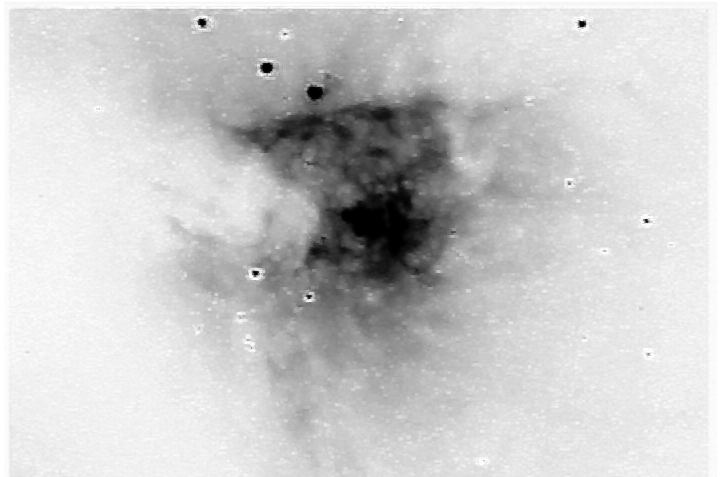
I'm also going to try experimenting with the HDR stacking filter in the Milsoslick capture software. This function captures and blends images taken with different exposure times to produce a more even and vivid image. All I need if for the weather to cooperate!
Subscribe to:
Posts (Atom)
Seven hours on the Horsehead with the Seestar S50
The Horsehead Nebula never gets old. This image is a seven hour integration taken with the S50. I procesed it in Siril with RC Astro tools a...

-
 I had a couple of emails asking how to defork an ETX telescope. The ETX 90 and ETX 125 were optically superb scopes, but the mounts left a...
-
 M17, the Omega Nebula (among other names). M17 is one of the brightest and most massive stellar nurseries in the galaxy. The open cluster o...
-
 The ZEQ25 doing its stuff on a cold night--imaging the Orion Nebula with an 8 inch f/4 astrograph. Note the lovely Christmas rug :) As ...