
Friday, March 28, 2025
The Christmas Tree Cluster
7 hours of integration on the Christmas Tree Nebula in Bortle 8/9 pulls out a reasonable amount of detail. This is a cropped image, stacked, drizzled, stretched and star processed in Siril, with final processing in Affinity 2 with JR macros.


The Rosette Nebula
The Rosette Nebula. This image has a total integration time of 4.5 hours (individual integrations of 45s at gain 60). Processed in Siril, Topaz Denoise, and Affinity Photo. Bortle 8/9.


M 42–6 hours of integration
6 hours of M42. Processed in Siril and Affinity Photo 2 with JR Macros. Zoom in on the core to see the 4 stars of the Trapezium.

Friday, March 7, 2025
M 42 with JR Astrophotography Macros
I've posted images of M 42 here before. It's a tough object, because bringing out faint nebulosity without blowing the core is a real challenge. There's also a temptation to over process, exaggerating details within the nebula at the expense of losing a more natural image. This image is a stack of 3 hours of 10s and 20s integrations. I stacked and removed stars in Siril. All other processing was done in Affinity 2, using the incredible JR Astrophotography macros. The result is an image with the core intact and subtle details of the nebula visible. I think it looks as if M42 and the Running Man are sailing on a stormy ocean. Again--full credit for this image goes to JR Macros!

Tuesday, February 18, 2025
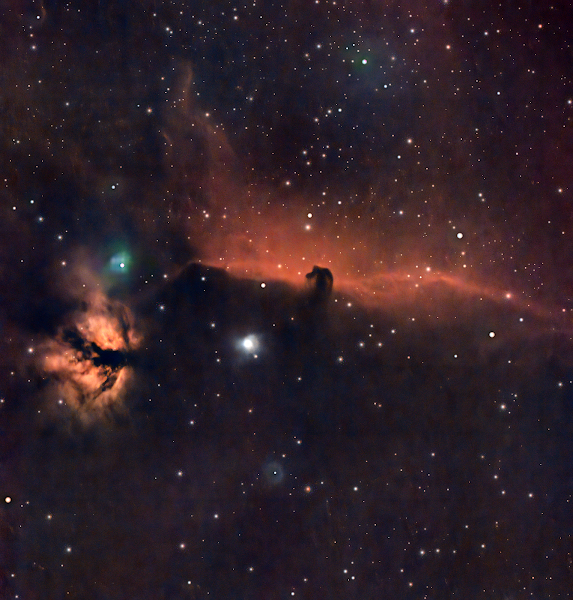
The Horsehead Nebula with the Dwarf 3
Here's an image of the Horsehead Nebula captured under my Bortle 8/9 skies. There's 2.38 hours of total integration time, captured in 45s/gain 60 individual exposures with DB filter. I processed the image in Siril, Topaz Denoise, and Affinity Photo.

Tuesday, February 11, 2025
The Moon--First Light with the D3
This is my first light image with the Dwarf D3. The moon was low in haze, and moved between tree branches during the imaging session. Nevertheless, the D3 captured a decent amount of detail for a 35mm imaging lens. This image is heavily cropped as the scope has a very wide field of view. The scope captures MP4 videos, and I took 1000 frames, coverted them to AVIs in PiPP, and stacked and processed 700 of them in Registax 6.


A New Toy--the Dwarf D3 telescope
Another toy arrived yesterday--the DWARFLAB D3--a tiny scope with a 35 mm 6-element apochromatic main imaging lens and small wideangle lens for Milky Way imaging (among other things). Of course, the clouds rolled in, but I was able to do some imaging, most of it through the clouds themselves. My first light object was the Moon, just to check focusing and function. I'll post that image later. The second was M42 because it is relatively bright and easy to capture. Setting up the scope in EQ mode was a simple, semi-automated process. The imaging chip in the scope, a Sony IMX678 Starvis 2 does an excellent job of capturing faint images with relatively low noise. I captured 40 minutes of M42 before heavy cloud came in, using the built-in narrowband filters in the scope. I drizzle processed the image stack in Siril as the scope significantly undersamples (making the native 4K frame 8K). I then heavily cropped the image horizontally, and the result (below) is quite pleasing. The original frame was much wider, and promises to offer great capabilites to image larger DSOs (like the Heart Nebula, for example). The scope is so small, you could almost clip it to your belt, so its a definite travel scope for me.
Subscribe to:
Posts (Atom)
Seven hours on the Horsehead with the Seestar S50
The Horsehead Nebula never gets old. This image is a seven hour integration taken with the S50. I procesed it in Siril with RC Astro tools a...

-
 I had a couple of emails asking how to defork an ETX telescope. The ETX 90 and ETX 125 were optically superb scopes, but the mounts left a...
-
 M17, the Omega Nebula (among other names). M17 is one of the brightest and most massive stellar nurseries in the galaxy. The open cluster o...
-
 The ZEQ25 doing its stuff on a cold night--imaging the Orion Nebula with an 8 inch f/4 astrograph. Note the lovely Christmas rug :) As ...