Thursday, March 31, 2016

M81--The Power of Stacking!

M81 is a faint galaxy and rather a challenge to image in light-polluted skies. A single image is disappointing--showing a bright center and a fuzzy halo. Increasing integration time and histogram stretching is one way to bring out more detail, but if the data is not there in the first place, these techniques yield little, and increased sky glow is more likely to degrade the image. Stacking is the best way to capture this missing data and to pull detail out of a relatively featureless image.

The first image shows a stack of seven, 30-second integrations with some aggressive histogram stretching. The spiral structure of the galaxy is just visible above the sky greenish glow.


The single, "raw" image below shows what one frame looks like. The benefits of stacking (even such a small number of frames) are pretty clear.


Wednesday, March 30, 2016

Betelgeuse, Betelgeuse, Betelgeuse!

Betelgeuse is one of the brightest and largest stars that can be seen with the naked eye. It is a red supergiant--so large that it would probably extend to the orbit of Jupiter if it replaced our sun! In stars, bigger is not always better and, despite the fact that it is less than 10 million years old, it close to the end of its life (by contrast, our sun is 4.6 billion years old and is only about halfway through its life).  Within the next million years, Betelgeuse is likely to explode in a Type II Supernova explosion. The supernova would be visible from earth for several weeks before fading, outshining the full moon as a magnitude -12 star. Current best estimates is that a supernova is most likely in the next 100,000 years.

This image was taken with the F/4 Newt and the DS 2.3+.


M1--Again

Last night presented some imaging opportunities through somewhat hazy skies, I set up the F/4 newt and the DS 2.3+ (with UHC filter) and set to work. I decided to capture my darks with a 30-second integration at gain 30. This combination offered a general dark set that could be used for most of the imaging session, offering also good control of amp glow that can appear in stacked images with histogram stretches.

Here is a full-frame image of M1. The integration time was 30 seconds, and this is a stack of 12 exposures (the best of the 20 or so I captured). Detail on the image is quite good and the skyglow and amp glow are well controlled. All in all, I'm pretty happy with this pic, which gives a good idea of the capabilities of the Newt/DS 2.3+ combination.


Saturday, March 26, 2016

M42 with the 14 inch

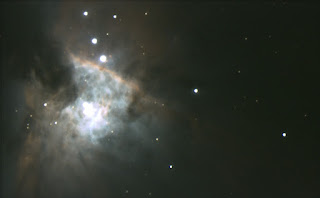
This is a stack of 5 x 5 second exposures of M42 taken with the 14 inch ACF, .5x focal reducer and DS 2.3+.


Here is the same image processed to emphasize the nebulosity:


Here is an original, single raw frame (with no processing):


The Sun 3.26.16

I decided to try the DS 2.3+ with the PST-DS today for some solar imaging. I was hoping I would not have to use a Barlow lens to achieve focus, but unfortunately, I had to. The good news is that the large chip in the 2.3+ still enabled me to image pretty much all of the solar disc. These images are stacks of around 30 of the best frames from the captured AVIs. No other tweaks have been made other than stacking and wavelet processing; the color is as captured.


Tuesday, March 22, 2016

Equinox Moon (3-20-16)

I took this pic of the Moon because it was pretty much washing everything else out. Taken close to the time of the Spring (or Vernal) Equinox, the image is a single, full-frame capture using the 8 inch f/4 Newt and the DS 2.3+.


Wednesday, March 9, 2016

The Crab Pulsar

Here is an image of the Crab taken with the 8 inch Newt and the DS 2.3+. It is a much enlarged image from the full frame image I posted a few days ago.  The pulsar itself is quite visible. The "blob" is actually two stars (as you can see if you look closely). The "upper" star is the pulsar.

For comparison sake, I've posted an unattributed image I found on Gene Smith's tutorial page at the UCSD Center for Astrophysics and Space Sciences which shows the pulsar.

The Pulsar in the Crab 

The Pulsar from an image on the UCSD Center for Astrophysics Site
The Crab Pulsar (PSR B0351+21) was "born" in the supernova of 1054. It was discovered in 1968 and is the first pulsar to be associated with a supernova. The stellar remnant is around 20km in diameter and pulses around 30 times a second.

Go here for an amazing image taken of the pulses by an amateur astronomer working in his back yard with a small 200mm aperture scope, a modified, inexpensive security camera, and a homebrew chopper wheel:
http://www.threehillsobservatory.co.uk/astro/astro_image_33.htm

Amazing work!

20 Hours of WR 134 with the Seestar S50

This image is a 20+ hour integration on WR 134, which is a highly energetic Wolf-Rayet star. The blue shockwave is oxygen ionized by the int...