Thursday, January 28, 2016

The Sun on 1.28.2016


The sun is finally clearing the trees again at my observatory site!  Here are two images of ARs 2488 (with the big "blobby" filament) and 2489 (with a small prominence visible). The Newton's Rings are a problem--I took these images with a Barlow (PST-DS scope) and ASI 120MM imager. Neverthless, it's good to be back imaging again!

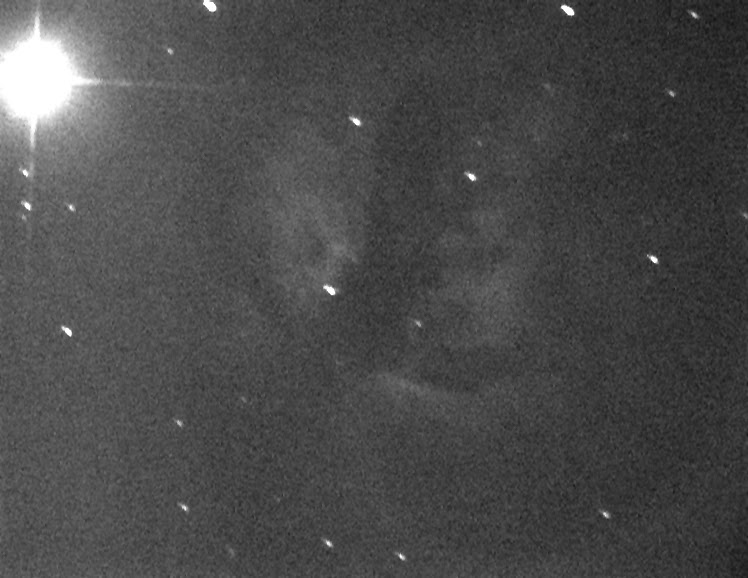
The Flame Nebula (NGC 2024) 1.27.16

I took advantage of some breaks in the clouds to do some imaging with the VRC and my DSm camera last night. The sky was a little hazy and bars of cloud moved over the imaged areas from time to time, but, as there was no moon, conditions were actually better than they were the last time I imaged a couple of days ago.

These are images of the Flame Nebula (NGC 2024). The bright star at the top of the image is Alnitak, which sends ultraviolet light into the Flame. This knocks electrons of the masses of hydrogen gas; the glow of the nebula is mostly from the recombining electrons and hydrogen. The nebula is part of the huge Orion Molecular Cloud--a star forming region. Note also the lanes of dark gas and dust in these images. The integrations were all around 20-30 seconds long with dark frame processing enabled.


Thursday, January 21, 2016

First Light 152mm VRC Mallincam Ritchey-Chretien Astrograph/ZEQ25 -- 12.20.2016

For the first time in months, we had clear skies and passable temperatures last night (20 degrees F!). I was finally able to take out my "Christmas Prezzie" of a 152mm Mallincam VRC and iOptron ZEQ25 mount. The pix below were captured with a Mallincam DSm, Orion focal reducer and a skyglow filter. Imaging was complicated by the fact that the gibbous moon was in the same area of the sky I was imaging (the Orion Nebula region).  While the moom washed out such faint objects as the Horsehead Nebula and the Flame Nebula, the Great Nebula itself was bright and prominent. These two images were captured with 5- and 10-second integrations with no dark frame processing. I adjusted the histogram for each in Photoshop.

The long exposure image really pulled out nebula detail; the VRC is a really high-contrast scope! The FOV enabled me to capture the main nebula and DeMairan's nebula, too (at approx. 6 o'clock position). All in-all, this is a great, compact, and inexpensive combination that enables you to get really great astro images!


Monday, November 16, 2015

Stacked Pinwheel Galaxy

Here is a stacked version of M33 taken under decent seeing conditions, but some wind. The camera was my trusty DSm fed by the ST-80. This is a stack of 5 1-minute exposures. The stars are slightly elongated due to the wind blowing on the scope. In this image, the dust lanes are definitely more prominent than on the unstacked images I posted earlier on this blog.


Wednesday, November 11, 2015

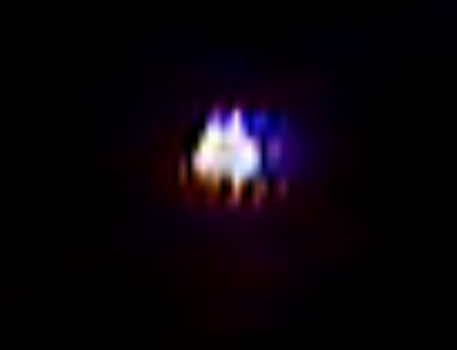
NGC 7023 (Caldwell 4) The Iris Nebula

The Iris Nebula is a bright emission nebula in the constellation Cepheus. It has a distinctive blue color. In the telescope field, it is a tiny, bright, blueish dot. The nebula is only 18 arcseconds by 18 arcseconds in angular diameter (as compared to 230 x 230 arcminutes for the ring nebula). These images were captured with the 14 inch, using a focal reducer, so the nebula looked like a bright star in the field. These images are heavily cropped and enlarged, showing some of the bright and dark structures in the nebula. The red and blue fringes are caused by aberrations in the optical system.


Monday, November 9, 2015

The Pleiades

The Pleiades, also known as the Seven Sisters, or the Netted Stars, have a large presence in myth a folklore. They are also a good test of eyesight in dark skies. With good vision, you should be able to see seven stars in the cluster.

In reality, there are hundreds of stars in the cluster. On a good night, I can see nine with my naked eye. Imaging shows hot blue stars surrounded by nebulousity.

This image as taken with the Orion ED 80 piggyback on the 14 inch ACF.  The imager was the Mallincam DSm.  Even with the 80nT f/5, the cluster is so large that only a few stars show. Note the nebulousity, especially around the star at the bottom of the image (Merope).

The Pinwheel Galaxy


 The Pinwheel Galaxy (M33) is, like M74, a very low surface brightness galaxy. It is fiendishly difficult to image in any but the darkest of skies. The Mallicam DSm can pull out more detail than any color imager under these conditions. This image was taken with the DSm, Orion Skyglow filter, and Orion ED 80 scope.

20 Hours of WR 134 with the Seestar S50

This image is a 20+ hour integration on WR 134, which is a highly energetic Wolf-Rayet star. The blue shockwave is oxygen ionized by the int...