Saturday, March 26, 2016

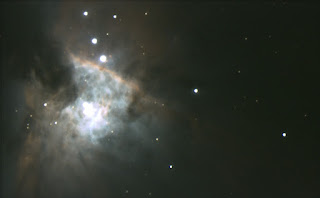
M42 with the 14 inch

This is a stack of 5 x 5 second exposures of M42 taken with the 14 inch ACF, .5x focal reducer and DS 2.3+.


Here is the same image processed to emphasize the nebulosity:


Here is an original, single raw frame (with no processing):


The Sun 3.26.16

I decided to try the DS 2.3+ with the PST-DS today for some solar imaging. I was hoping I would not have to use a Barlow lens to achieve focus, but unfortunately, I had to. The good news is that the large chip in the 2.3+ still enabled me to image pretty much all of the solar disc. These images are stacks of around 30 of the best frames from the captured AVIs. No other tweaks have been made other than stacking and wavelet processing; the color is as captured.


Tuesday, March 22, 2016

Equinox Moon (3-20-16)

I took this pic of the Moon because it was pretty much washing everything else out. Taken close to the time of the Spring (or Vernal) Equinox, the image is a single, full-frame capture using the 8 inch f/4 Newt and the DS 2.3+.


Wednesday, March 9, 2016

The Crab Pulsar

Here is an image of the Crab taken with the 8 inch Newt and the DS 2.3+. It is a much enlarged image from the full frame image I posted a few days ago.  The pulsar itself is quite visible. The "blob" is actually two stars (as you can see if you look closely). The "upper" star is the pulsar.

For comparison sake, I've posted an unattributed image I found on Gene Smith's tutorial page at the UCSD Center for Astrophysics and Space Sciences which shows the pulsar.

The Pulsar in the Crab 

The Pulsar from an image on the UCSD Center for Astrophysics Site
The Crab Pulsar (PSR B0351+21) was "born" in the supernova of 1054. It was discovered in 1968 and is the first pulsar to be associated with a supernova. The stellar remnant is around 20km in diameter and pulses around 30 times a second.

Go here for an amazing image taken of the pulses by an amateur astronomer working in his back yard with a small 200mm aperture scope, a modified, inexpensive security camera, and a homebrew chopper wheel:
http://www.threehillsobservatory.co.uk/astro/astro_image_33.htm

Amazing work!

Reprocessed M42

Here is a reprocessed image of M42. It is 10 x 15 second frames, stacked and color-balanced in Nebulosity with final tweaking in Photoshop. I deliberately "blew out" the core in this image so that the subtle details in the surrounding gas cloud are more visible.

Eqpt: F/4 Newt; DS 2.3+; Orion Skyglow Imaging Filter.

New Imaging Platforms: Mallincam VRC 6, F/4 Newt, Skyraider DS 2.3+, IOptron ZEQ 25

I've just added some new capabilities to the Observatory. These additions enable wide-field, fast imaging of DSOs.
,
The foundation is the iOptron ZEQ 25. This mount can carry a 28 pound payload, so it is a perfect match of the new scope (it has already proven itself with the VRC 6). In use, I've found it very easy to polar align, with GOTOs that put the imaged object on the imaging chip 100% of the time. The tracking is superb--I've used 2-3 minute unguided exposures and achieved round stars (though a breeze will cause problems). All in all, it's a great, relatively low-cost mount and it works perfectly with the Newt.

Mallicam VRC 6, IOptron ZEQ 25, MC JrPro 
The Ritchey-Chretien VRC 6 and the F/4 Newtonian astrographs are great additions to the observatory. They produce superb images that rival those of fine apochromatic refractors at a fraction of the price. Mallincam's excellent QC ensures that the optics are truly diffraction-limited and the scopes arrive perfectly collimated.

The Mallincam Newt F/4, iOptron ZEQ 25 and the DS 2.3+ imaging M42

The Mallincam DS 2.3+ is a 1920 x 1080 Class 0 Scientific Grade CMOS imager. It offers a really compelling combination of decent resolution and sensitivity. Earlier blog posts show just how well it performs with very short integration times.

I'm very happy with the capabilities both the VRC 6 and the Newt have added to the observatory. I just hope the weather clears soon so I can get back out with them!
Thursday, March 3, 2016

Crab--full frame

Like the Horsehead Nebula posted the other day, this pic gives a good idea of the FOV of the f/3.9 Newtonian astrograph. The image shows a wide swath of sky with no visible vignetting. The pearly glow at the edges is likely a combination of amp glow and glow from a local lighting source. This image is 9, 30-second exposures, stacked in Nebulosity with final histogram adjustments in Photoshop.


20 Hours of WR 134 with the Seestar S50

This image is a 20+ hour integration on WR 134, which is a highly energetic Wolf-Rayet star. The blue shockwave is oxygen ionized by the int...